



SEARCH
OUR SERVICE
TECNOLOGY
ATEX Certificate
|
I. What is ATEX? ATEX is one of CE Directive,a mandatory requirement for explosion-proof equipment and protective systems to be used in EU market. It applies to equipment and protective systems intended for use in potentially explosive atmospheres. This Directive covers both mining and non-mining equipment, and extends potentially explosive atmospheres to include dust, flammable gases, flammable vapours and mists in the air. The new directive code is 2014/34/EU (formerly 94/9/EC). |
 |
II. Scope of the ATEX Directive
1. Shall apply to:
(a) equipment and protective systems intended for use in potentially explosive atmospheres;
(b) safety devices, controlling devices and regulating devices intended for use outside potentially explosive atmospheres but required for or contributing to the safe functioning of equipment and protective systems with respect to the risks of explosion;
(c) components intended to be incorporated into equipment and protective systems referred to in point.
2. Shall not apply to:
(a) medical devices intended for use in a medical environment;
(b) equipment and protective systems where the explosion hazard results exclusively from the presence of explosive substances or unstable chemical substances;
(c) equipment intended for use in domestic and non-commercial environments where potentially explosive atmospheres may only rarely be created, solely as a result of the accidental leakage of fuel gas;
(d) personal protective equipment covered by Council Directive 89/686/EEC of 21 December 1989 on the approximation of the laws of the Member States relating to personal protective equipment;
(e) seagoing vessels and mobile offshore units together with equipment on board such vessels or units;
(f) means of transport, i. e. vehicles and their trailers intended solely for transporting passengers by air or by road, rail or water networks, as well as means of transport in so far as such means are designed for transporting goods by air, by public road or rail networks or by water. Vehicles intended for use in a potentially explosive atmosphere shall not be excluded from the scope of this Directive;
(g) the equipment covered by point (b) of Article 346(1) of the Treaty on the Functioning of the European Union.
III. Basic content of the ATEX Directive
1. Equipment-Group
Group I: mining equipment
Group II: non-mining equipment
2. Equipment-Category:
Equipment category M1
Equipment category M2
Equipment category 1
Equipment category 2
Equipment category 3
3. G and D:
G: concerning explosive atmospheres caused by gases, vapours or mists
D: concerning explosive atmospheres caused by dust
IV:ATEX Certificate modules
1. Module A: Internal Production Control
2. Module B: Eu-Type Examination
3. Module C1: Conformity To Type Based On Internal Production Control Plus Supervised Product Testing
4. Module D: Conformity To Type Based On Quality Assurance Of The Production Process
5. Module E: Conformity To Type Based On Product Quality Assurance
6. Module F: Conformity To Type Based On Product Verification
7. Module G: Conformity Based On Unit Verification
V: ATEX Harmonized Standards
1. EN 60079-0 Explosive atmospheres Part 0: Equipment-General requirements
2. EN 60079-1 Explosive atmospheres Part 1: Equipment protection by flameproof endosures "d"
3. EN 60079-2 Explosive atmospheres Part 2: Equipment protection by pressurized enclosure "p"
4. EN 60079-5 Explosive atmospheres Part 5: Equipment protection by powder filling "q"
5. EN 60079-6 Explosive atmospheres Part 6: Equipment protection by liquid immersion "o"
6. EN 60079-7 Explosive atmospheres Part 7: Equipment protection by increased safety "e"
7. EN 60079-11 Explosive atmospheres Part 11: Equipment protection by intrinsic safety "i"
8. EN 60079-15 Explosive atmospheres Part 15: Equipment protection by type of protection "n"
9. EN 60079-18 Explosive atmospheres Part 18: Equipment protection by encapsulation "m
10. EN 60079-28 Explosive atmospheres Part 28: Protection of equipment and transmission systems using optical radiation
11. EN 60079-31 Explosive atmospheres Part 31: Equipment dust ignition protection by enclosure "t"
12. EN 60079-33 Explosive atmospheres Part 33: Equipment protection by special protection "s"
13. EN 1127-1: 2019 Explosive atmospheres-Explosion prevention and protection - Part 1: Basic concepts and methodology
14. EN 50050-1: 2013 Electrostatic hand-held spraying equipment-Safety requirements - Part 1: Hand-held spraying equipment for ignitable liquid coating materials
15. EN 14491: 2012 Dust explosion venting protective systems
16. EN ISO 16852: 2016 Flame arresters-Performance requirements, test methods and limits for use (ISO 16852: 2016)
17. EN ISO 80079-36: 2016 Explosive atmospheres-Part 36: Non-electrical equipment for explosive atmospheres-Basic method and requirements (ISO 80079-36: 2016)
18. EN ISO 80079-37: 2016 Explosive atmospheres-Part 37: Non-electrical equipment for explosive atmospheres-Non-electrical type of protection constructional safety ''c'', control of ignition sources ''b'', liquid immersion ''k'' (ISO 80079-37: 2016)
19. EN ISO/IEC 80079-38: 2016 Explosive atmospheres-Part 38: Equipment and components in explosive atmospheres in underground mines (ISO/IEC 80079-38: 2016)
ect
VI. ATEX Ex Marking
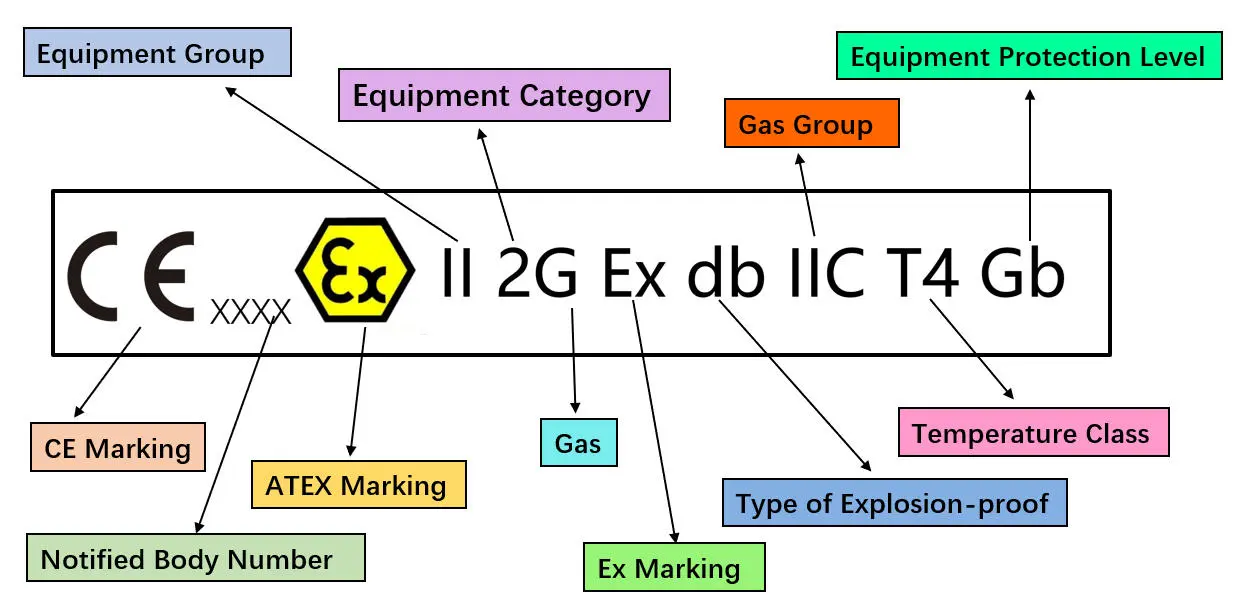
1. CE: ATEX is one of CE Directives
2. XXXX: NB(Notified Body) number
| 3. | |
: ATEX Certificate Marking |
4. Group II: non-mining equipment,("I" for equipment used in mining environments, and "II" for equipment used in non-mining environments. )
5. Category 2: a high level of protection(Equipment in this category is intended for use in areas in which explosive atmospheres caused by gases, vapours, mists or air/dust mixtures are likely to occur occasionally. )
6. G: gas atmosphere(D: dust atmosphere. )
7. Ex: explosion-proof
8. db: flameproof enclosure(the type of explosion-proof protection).
9. IIC: type of Gas(Representative gases: hydrogen and acetylene)
10. T4: the temperature class,the maximum surface temperature does not exceed 135°C.
11. Gb: equipment protection level(EPL), suitable for Zones 1 and Zones 2.
I. What is ATEX?
ATEX is one of CE Directive,a mandatory requirement for explosion-proof equipment and protective systems to be used in EU market.
It applies to equipment and protective systems intended for use in potentially explosive atmospheres.
This Directive covers both mining and non-mining equipment, and extends potentially explosive atmospheres to include dust, flammable gases, flammable vapours and mists in the air.
The new directive code is 2014/34/EU (formerly 94/9/EC).
II. Scope of the ATEX Directive
1. Shall apply to:
(a) equipment and protective systems intended for use in potentially explosive atmospheres;
(b) safety devices, controlling devices and regulating devices intended for use outside potentially explosive atmospheres but required for or contributing to the safe functioning of equipment and protective systems with respect to the risks of explosion;
(c) components intended to be incorporated into equipment and protective systems referred to in point.
2. Shall not apply to:
(a) medical devices intended for use in a medical environment;
(b) equipment and protective systems where the explosion hazard results exclusively from the presence of explosive substances or unstable chemical substances;
(c) equipment intended for use in domestic and non-commercial environments where potentially explosive atmospheres may only rarely be created, solely as a result of the accidental leakage of fuel gas;
(d) personal protective equipment covered by Council Directive 89/686/EEC of 21 December 1989 on the approximation of the laws of the Member States relating to personal protective equipment;
(e) seagoing vessels and mobile offshore units together with equipment on board such vessels or units;
(f) means of transport, i. e. vehicles and their trailers intended solely for transporting passengers by air or by road, rail or water networks, as well as means of transport in so far as such means are designed for transporting goods by air, by public road or rail networks or by water. Vehicles intended for use in a potentially explosive atmosphere shall not be excluded from the scope of this Directive;
(g) the equipment covered by point (b) of Article 346(1) of the Treaty on the Functioning of the European Union.
III. Basic content of the ATEX Directive
1. Equipment-Group
Group I: mining equipment
Group II: non-mining equipment
2. Equipment-Category:
Equipment category M1
Equipment category M2
Equipment category 1
Equipment category 2
Equipment category 3
3. G and D:
G: concerning explosive atmospheres caused by gases, vapours or mists
D: concerning explosive atmospheres caused by dust
IV:ATEX Certificate modules
1. Module A: Internal Production Control
2. Module B: Eu-Type Examination
3. Module C1: Conformity To Type Based On Internal Production Control Plus Supervised Product Testing
4. Module D: Conformity To Type Based On Quality Assurance Of The Production Process
5. Module E: Conformity To Type Based On Product Quality Assurance
6. Module F: Conformity To Type Based On Product Verification
7. Module G: Conformity Based On Unit Verification
V: ATEX Harmonized Standards
1. EN 60079-0 Explosive atmospheres Part 0: Equipment-General requirements
2. EN 60079-1 Explosive atmospheres Part 1: Equipment protection by flameproof endosures "d"
3. EN 60079-2 Explosive atmospheres Part 2: Equipment protection by pressurized enclosure "p"
4. EN 60079-5 Explosive atmospheres Part 5: Equipment protection by powder filling "q"
5. EN 60079-6 Explosive atmospheres Part 6: Equipment protection by liquid immersion "o"
6. EN 60079-7 Explosive atmospheres Part 7: Equipment protection by increased safety "e"
7. EN 60079-11 Explosive atmospheres Part 11: Equipment protection by intrinsic safety "i"
8. EN 60079-15 Explosive atmospheres Part 15: Equipment protection by type of protection "n"
9. EN 60079-18 Explosive atmospheres Part 18: Equipment protection by encapsulation "m
10. EN 60079-28 Explosive atmospheres Part 28: Protection of equipment and transmission systems using optical radiation
11. EN 60079-31 Explosive atmospheres Part 31: Equipment dust ignition protection by enclosure "t"
12. EN 60079-33 Explosive atmospheres Part 33: Equipment protection by special protection "s"
13. EN 1127-1: 2019 Explosive atmospheres-Explosion prevention and protection - Part 1: Basic concepts and methodology
14. EN 50050-1: 2013 Electrostatic hand-held spraying equipment-Safety requirements - Part 1: Hand-held spraying equipment for ignitable liquid coating materials
15. EN 14491: 2012 Dust explosion venting protective systems
16. EN ISO 16852: 2016 Flame arresters-Performance requirements, test methods and limits for use (ISO 16852: 2016)
17. EN ISO 80079-36: 2016 Explosive atmospheres-Part 36: Non-electrical equipment for explosive atmospheres-Basic method and requirements (ISO 80079-36: 2016)
18. EN ISO 80079-37: 2016 Explosive atmospheres-Part 37: Non-electrical equipment for explosive atmospheres-Non-electrical type of protection constructional safety ''c'', control of ignition sources ''b'', liquid immersion ''k'' (ISO 80079-37: 2016)
19. EN ISO/IEC 80079-38: 2016 Explosive atmospheres-Part 38: Equipment and components in explosive atmospheres in underground mines (ISO/IEC 80079-38: 2016)
ect
VI. ATEX Marking
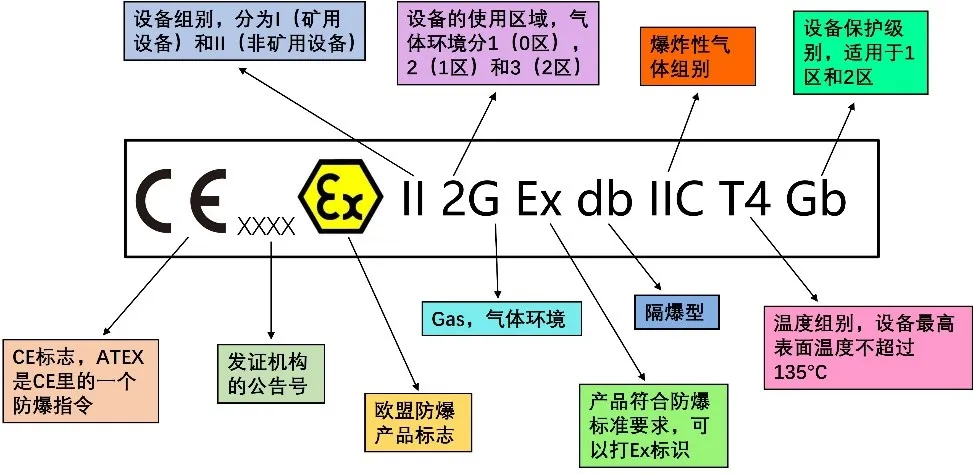
1. CE: ATEX is one of CE Directives
2. XXXX: NB(Notified Body) number
| 3. | |
: ATEX Certificate Marking |
4. Group II: non-mining equipment,("I" for equipment used in mining environments, and "II" for equipment used in non-mining environments. )
5. Category 2: a high level of protection(Equipment in this category is intended for use in areas in which explosive atmospheres caused by gases, vapours, mists or air/dust mixtures are likely to occur occasionally. )
6. G: gas atmosphere(D: dust atmosphere. )
7. Ex: explosion-proof
8. db: flameproof enclosure(the type of explosion-proof protection).
9. IIC: type of Gas(Representative gases: hydrogen and acetylene)
10. T4: the temperature class,the maximum surface temperature does not exceed 135°C.
11. Gb: equipment protection level(EPL), suitable for Zones 1 and Zones 2.
Give us a free quote
Submit this form and our sales representative will contact you soon.
Service
Contact Information
Shenzhen Sino Testing Services Co., Ltd.
Tel:
+86 199 2539 5926
WeChat: 19925395926
Address: 13F, Building C, Kangjia Guangming Technology Center, No. 288 Xingxin Road, Guangming District, Shenzhen, Guangdong, China.
Contact us

Official Account

Tik Tok

Xiaohongshu
Copyright © 2026 Shenzhen Sino Testing Services Co., Ltd.